

Industry Insights
Automation has changed advertising forever.
But persuasion is still human.
- Industry Insights
- Performance in 2026 Is About Outcomes, Not Output
- Why AI-Generated Ads Often Plateau
- Human-Created Ads Still Win on Trust
- Conversion Data Tells a Clear Story
- AI Advertising Trends Reveal a Shift Toward Hybrid Models
- Why AI Alone Struggles With Funnel Alignment
- Creativity, Context, and Cultural Intelligence
- Measuring the Right Metrics Changes the Outcome
- What High-Performing Teams Do Differently
- Common Mistakes Brands Make With AI Ads
- Closing Insights : The Future Is Not AI vs Human, It Is AI With Human
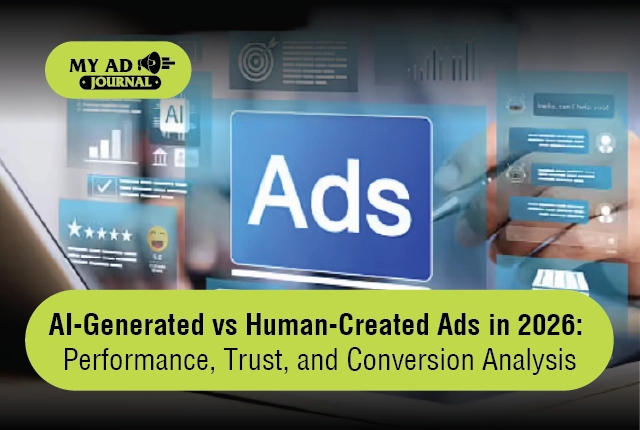
In 2026, brands are producing more ads than ever before. AI tools generate headlines in seconds, visuals in minutes, and full campaigns in hours. Yet despite this speed and scale, performance gaps are widening.
The central debate shaping modern marketing today is no longer whether to use AI, but how much to rely on it.
Understanding AI generated ads vs human ads reveals a critical reality: efficiency does not automatically translate into effectiveness.
Campaigns succeed not by how fast ads are created, but by how deeply they connect.
Modern data now shows where AI excels, where it falls short, and why human creativity still plays a decisive role in trust and conversion.
Performance in 2026 Is About Outcomes, Not Output
In theory, AI should outperform humans.
It processes more data.
It tests faster.
It optimizes continuously.
Yet AI advertising performance reports in 2026 show mixed results.
While AI-generated ads dominate in:
- A/B testing speed
- Cost efficiency
- Scalable variations
They consistently underperform in:
- Emotional resonance
- Brand trust
- Long-term recall
Performance is no longer measured by impressions or clicks alone. Modern campaigns are evaluated by conversion quality, retention, and trust signals, areas where purely AI-driven ads struggle.
This is where the divide between human vs AI advertising becomes clear.
Why AI-Generated Ads Often Plateau
AI systems are trained on patterns.
They optimize for what has worked before.
But advertising success in 2026 depends on what feels relevant now.
Data-driven AI marketing effectiveness shows that AI-generated ads often fail when:
- Messaging becomes repetitive across audiences
- Tone feels generic or emotionally flat
- Contextual nuance is missing
- Cultural sensitivity is overlooked
AI excels at optimization, but struggles with intuition.
This explains why many campaigns see early performance spikes followed by rapid fatigue. AI can find winning patterns, but it cannot invent meaning.
Human-Created Ads Still Win on Trust
Trust has become the most valuable currency in advertising.
In a landscape flooded with content, consumers have developed a heightened ability to sense automation. Subtle cues in tone, storytelling, and emotional pacing influence perception more than ever.
Human-created ads consistently outperform AI-generated ones in:
- Brand credibility
- Emotional connection
- Story-driven persuasion
- Complex value communication
This directly impacts AI ad conversion rate comparisons.
While AI ads may generate clicks, human-led creatives are more likely to convert high-intent users, especially in:
- Financial services
- Automotive
- Healthcare
- High-ticket products
Trust cannot be automated.
Conversion Data Tells a Clear Story
Advertising performance analysis in 2026 highlights a key trend: AI drives volume. Humans drive value.
Campaigns relying entirely on AI-generated creatives often show:
- Higher bounce rates
- Lower average order values
- Reduced lifetime customer value
Meanwhile, human-guided campaigns deliver:
- Better lead quality
- Stronger post-click engagement
- Higher assisted conversion rates
This does not mean AI is ineffective. It means AI marketing effectiveness peaks when paired with human strategy, not when replacing it.
AI Advertising Trends Reveal a Shift Toward Hybrid Models
The most successful brands in 2026 are no longer choosing sides.
They are adopting hybrid creative systems, combining:
- AI for testing, scaling, and optimization
- Humans for storytelling, positioning, and emotional framing
Emerging AI advertising trends show that top-performing teams use AI to:
- Generate creative variants
- Analyze performance signals
- Predict fatigue
But humans still:
- Define the core message
- Shape brand voice
- Control narrative consistency
This balance is redefining AI generated ads vs human ads as a collaboration, not a competition.
Why AI Alone Struggles With Funnel Alignment
Another performance gap appears in funnel-specific messaging.
Data shows:
- Awareness-stage AI ads often lack intrigue
- Consideration-stage AI ads feel informational but uninspiring
- Conversion-stage AI ads lack trust reinforcement
Human creatives intuitively understand:
- When to inform
- When to persuade
- When to reassure
This explains why human vs AI advertising comparisons consistently favor human-led strategy at the lower funnel, where emotional reassurance and credibility matter most.
Creativity, Context, and Cultural Intelligence
AI is trained globally.
Audiences behave locally.
One of the biggest limitations affecting AI advertising performance is cultural nuance. Slang, humor, emotional triggers, and social context vary dramatically across regions.
Human creatives adapt messaging based on:
- Cultural expectations
- Market maturity
- Social sentiment
- Brand perception
AI can replicate language, but it cannot feel context.
This gap becomes increasingly visible in global campaigns where AI-generated ads fail to resonate beyond surface-level relevance.
Measuring the Right Metrics Changes the Outcome
Many brands misjudge AI marketing effectiveness because they measure the wrong success signals.
Clicks do not equal trust.
Engagement does not equal intent.
Advanced teams now evaluate:
- Conversion depth
- Scroll behavior
- Message recall
- Post-click behavior
- Creative fatigue velocity
When measured this way, human-created ads consistently demonstrate longer performance sustainability compared to purely AI-generated ones.
What High-Performing Teams Do Differently
Brands winning in 2026 follow a clear creative philosophy:
- AI supports execution
- Humans own strategy
Their approach includes:
- Human-defined messaging frameworks
- AI-powered creative testing
- Continuous learning loops
- Human-led interpretation of data
This model delivers stronger AI ad conversion rate results than AI-only systems.
Because creativity without judgment is automation.
And judgment is still human.
Common Mistakes Brands Make With AI Ads
Despite access to advanced tools, many brands still fail when:
- AI replaces creative thinking instead of supporting it
- Messaging is optimized for platforms, not people
- Speed is prioritized over substance
- Performance data is followed blindly
These mistakes weaken human vs AI advertising outcomes and erode long-term brand equity.
Closing Insights : The Future Is Not AI vs Human, It Is AI With Human
The debate around AI generated ads vs human ads misses the real point.
AI is not here to replace creativity.
It is here to accelerate it.
When brands understand true AI advertising performance, apply AI where it excels, and preserve human insight where it matters most, advertising becomes more effective, not less.
In 2026, winning ads are not fully automated.
They are intelligently guided.
Because people don’t connect with algorithms.
They connect with meaning.
And meaning is still human-made.