

Industry Insights
Your ads aren’t failing.
They’re being ignored.
- Industry Insights
- Creative Fatigue Is No Longer a Slow Burn
- Why Advertising Creative Fatigue Is Accelerating
- The Psychology Behind Faster Ad Exhaustion
- Platform Algorithms Are Making Fatigue Worse
- Signs Your Campaign Is Experiencing Creative Fatigue
- Why Ad Performance Decline Happens Even With Perfect Targeting
- Creative Fatigue Is a Strategic Problem, Not a Design Flaw
- The Role of Campaign Creative Refresh Strategy
- Data Shows Relevance Beats Frequency
- What High-Performing Brands Do Differently
- Common Mistakes That Accelerate Creative Fatigue
- Final Verdicts : Fatigue Is the New Bottleneck
In 2026, audiences are exposed to thousands of marketing messages every single day. Platforms are faster, targeting is sharper, and distribution is effortless.
Yet despite this, brands are experiencing shorter performance windows and steeper drop-offs than ever before.
The reason is no longer poor targeting or weak budgets.
It is creative fatigue advertising.
Understanding how and why creative fatigue accelerates in 2026 reveals a hard truth: attention is not just scarce, it is defensive. Ads do not lose performance gradually anymore. They collapse suddenly.
Creative Fatigue Is No Longer a Slow Burn
In previous years, ad fatigue built over weeks.
In 2026, it will be built in days.
Modern ad fatigue 2026 data shows that:
- High-performing creatives peak faster
- Engagement decay happens sooner
- Frequency thresholds are lower
- Audience tolerance is shrinking
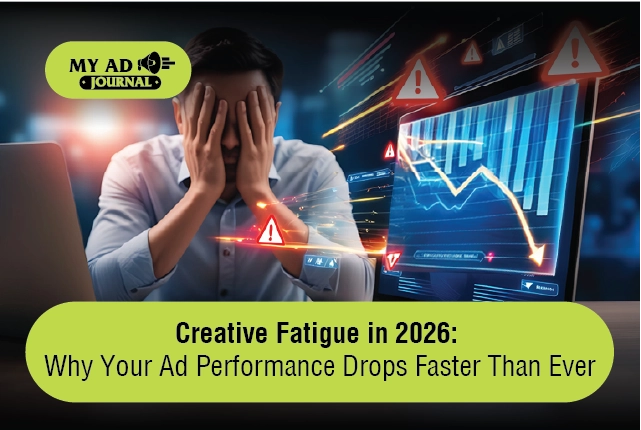
This explains why brands see strong early results followed by an abrupt ad performance decline, even when targeting and spend remain unchanged.
Fatigue is no longer a warning sign.
It is a performance cliff.
Why Advertising Creative Fatigue Is Accelerating
The speed of digital advertising has fundamentally changed.
Campaigns are launched faster.
Iterations happen quicker.
Audiences recognize patterns instantly.
Advertising creative fatigue accelerates when:
- Visual structures repeat across campaigns
- Messaging frameworks remain unchanged
- Hooks feel predictable
- Platform-native formats are underutilized
What once felt familiar now feels disposable.
Audiences don’t consciously reject ads, they subconsciously filter them out.
The Psychology Behind Faster Ad Exhaustion
Creative fatigue is not about dislike.
It is about cognitive overload.
In 2026, users have developed:
- Faster pattern recognition
- Shorter attention tolerance
- Higher expectation of relevance
When the brain predicts the outcome of an ad within seconds, it disengages.
This is the core driver of creative fatigue marketing failure: repetition triggers avoidance, not recall.
Platform Algorithms Are Making Fatigue Worse
Ad platforms reward early performance.
They punish stagnation.
When creatives perform well initially:
- Algorithms increase delivery
- Frequency spikes rapidly
- Saturation occurs sooner
This creates a paradox.
The better your ad performs, the faster creative fatigue advertising sets in, unless proactive refresh systems are in place.
Performance success now accelerates creative exhaustion.
Signs Your Campaign Is Experiencing Creative Fatigue
Brands often misdiagnose fatigue as a targeting issue.
In reality, advertising creative fatigue reveals itself through:
- Stable impressions but falling engagement
- Rising CPMs without audience expansion
- Click-through rate decay
- Reduced conversion quality
- Increased negative feedback
These are not media problems.
They are creative saturation signals.
Why Ad Performance Decline Happens Even With Perfect Targeting
Targeting defines who sees the ad.
Creativity determines whether they care.
In 2026, ad performance decline occurs even in well-segmented audiences because:
- Messaging remains static
- Value propositions stop feeling new
- Emotional triggers lose impact
Audiences evolve faster than campaigns.
When creativity fails to evolve with them, performance drops, regardless of precision targeting.
Creative Fatigue Is a Strategic Problem, Not a Design Flaw
Many brands respond to fatigue by:
- Changing colors
- Swapping visuals
- Editing copy slightly
These are cosmetic fixes.
True creative fatigue marketing solutions require:
- Message rotation, not just asset variation
- Funnel-stage creative alignment
- Narrative progression across ads
Without strategic change, new visuals carry the same old fatigue.
The Role of Campaign Creative Refresh Strategy
In 2026, refresh is no longer reactive.
A strong campaign creative refresh strategy includes:
- Pre-planned creative lifecycles
- Modular messaging frameworks
- Weekly performance-based creative decisions
- Intent-aligned creative swaps
Winning brands refresh before fatigue appears, not after performance collapses.
Refresh is now a system, not an action.
Data Shows Relevance Beats Frequency
Modern performance analysis confirms:
- Fewer, smarter creatives outperform high-volume repetition
- Contextual relevance extends creative lifespan
- Platform-native storytelling reduces fatigue
This shifts the focus of creative fatigue advertising from volume to value.
Relevance slows fatigue.
Repetition accelerates it.
What High-Performing Brands Do Differently
Brands that resist ad fatigue 2026 follow consistent principles:
- They treat creative as a living system
- They build multiple angles, not single ideas
- They test messages, not just formats
- They refresh narratives, not just visuals
This approach reduces advertising creative fatigue while maintaining performance stability.
Common Mistakes That Accelerate Creative Fatigue
Even advanced teams fall into these traps:
- Running one “winning” creative too long
- Refreshing too late
- Ignoring frequency signals
- Optimizing media while neglecting messaging
These mistakes explain why ad performance decline happens faster in 2026 than ever before.
Final Verdicts : Fatigue Is the New Bottleneck
Creative fatigue is not a platform issue.
It is not an audience issue.
It is not a budget issue.
It is a strategic failure to evolve creativity at the speed of attention.
When brands understand creative fatigue advertising, implement intelligent campaign creative refresh strategy, and treat creativity as a dynamic performance lever, campaigns stop collapsing, and start compounding.
In 2026, ads don’t die because they are bad.
They die because they stay the same.
And in a world of infinite content, sameness is invisible.