


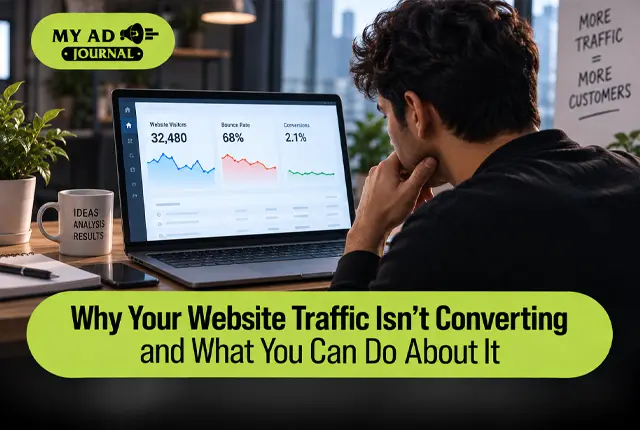
Getting visitors to your website is an important part of digital marketing, but traffic alone does not guarantee business growth. A website can receive thousands of visitors every month and still generate very few enquiries, signups, purchases or leads.
- What Does Website Traffic Not Converting Mean?
- Why Is Your Website Traffic Not Converting?
- 7 Reasons Your Website Traffic Isn’t Converting
- 1. You Are Attracting the Wrong Audience
- 2. Your Content Does Not Match Search Intent
- 3. Your Value Proposition Is Unclear
- 4. Your Calls to Action Are Weak
- 5. Your Website Does Not Build Enough Trust
- 6. The User Experience Creates Friction
- 7. Your Content Is Created for Search Engines Instead of People
- How to Increase Website Conversions
- Create Content That Helps Visitors Make Decisions
- Improve Your Website Conversion Rate With Better Landing Pages
- Turn Website Visitors Into Customers With Better Customer Journeys
- Measure the Right Conversion Metrics
- Common Mistakes That Can Reduce Website Conversions
- A People First Approach to Website Content
- Final Thoughts
- Turn More Website Traffic Into Meaningful Results
- FAQs
If you are wondering why website traffic is not converting, the problem may not be the amount of traffic you receive. It could be the quality of your visitors, the relevance of your content, the user experience, your calls to action or the journey you create between the first visit and the final conversion.
Website traffic and conversions are two different parts of the marketing process. Traffic brings people to your website, while conversion strategies give those visitors a reason and an easy path to take action.
Understanding where visitors lose interest can help businesses improve their websites and turn more existing traffic into meaningful results.
What Does Website Traffic Not Converting Mean?
The phrase website traffic not converting refers to a situation where people visit a website but do not complete the action the business wants them to take.
That action could be making a purchase, submitting a contact form, requesting a quote, booking an appointment, downloading a resource, signing up for a newsletter or contacting the business.
A website does not necessarily need to convert every visitor. Different users arrive with different levels of awareness and intent. Some may simply be researching a topic, while others may already be ready to buy.
The objective is to understand those visitors and provide useful information that helps them move towards the appropriate next step.
Google’s guidance recommends creating content primarily for people, with the goal of helping visitors achieve their objectives and leave the page with a satisfying experience.
Why Is Your Website Traffic Not Converting?
There can be several reasons behind a low website traffic conversion rate.
Your website may be attracting people who are not part of your target audience. Your landing page may not match the promise that brought visitors there. Your messaging may be unclear, your CTA may be difficult to find or your website may not provide enough information to build confidence.
Sometimes, the problem is even simpler: visitors cannot immediately understand what the business offers or what they are supposed to do next.
The first step towards improving conversions is therefore not adding more traffic. It is identifying where the existing customer journey is breaking down.
Also Read: AI-Generated vs Human-Created Ads in 2026: Performance, Trust, and Conversion Analysis
7 Reasons Your Website Traffic Isn’t Converting
1. You Are Attracting the Wrong Audience
More visitors do not automatically mean more customers.
If your SEO, advertising or social media campaigns attract people who are unlikely to purchase your products or services, your traffic numbers may look impressive while your conversions remain low.
For example, a business selling premium professional software may receive significant traffic from people searching for free tools. Those visitors may have little interest in becoming paying customers.
This is why businesses need to evaluate traffic quality rather than looking only at visitor volume.
Review where your visitors come from, which keywords they use, which pages they visit and what actions they take.
If large amounts of traffic come from audiences with low purchase intent, improving targeting may have a bigger impact than simply trying to generate more visitors.
2. Your Content Does Not Match Search Intent
One of the most common reasons for website traffic not converting is a mismatch between what visitors expect and what they find.
Imagine someone searches for “best accounting software for small businesses” and lands on a page that only provides a generic company introduction.
The visitor may leave because the page does not answer the question that brought them there.
Content should address the user’s actual need.
Google encourages content creators to ask whether their pages provide substantial, complete information and whether visitors will feel they have learned enough to achieve their goal.
Understanding search intent can therefore help businesses create pages that connect the visitor’s initial question with the next logical action.
3. Your Value Proposition Is Unclear
Visitors should not have to work hard to understand what your business offers.
A strong website should communicate the key value proposition quickly. What do you offer? Who is it for? What problem does it solve? Why should someone consider your solution?
If your homepage or landing page contains vague statements without explaining the actual benefit, visitors may not see a reason to continue.
Clear messaging helps reduce uncertainty.
Instead of focusing only on what your company does, explain how your product or service can help the customer.
A visitor should be able to understand the core benefit without reading several pages of content.
4. Your Calls to Action Are Weak
A visitor may be interested in your product but still leave because there is no obvious next step.
Calls to action guide users towards conversion. Depending on the business, they could include “Get a Quote”, “Book a Demo”, “Start Free Trial”, “Contact Us”, “Shop Now” or “Download the Guide”.
A CTA should be clear and relevant to the visitor’s stage in the buying journey.
A person reading an introductory blog may not be ready to make a purchase immediately. However, they may be interested in downloading a useful guide, exploring a related service or joining an email list.
Providing appropriate next steps can help move visitors through the customer journey instead of forcing every visitor towards an immediate sale.
5. Your Website Does Not Build Enough Trust
People are more likely to take action when they feel confident about a business.
If a website provides little information about the company, product, service or people behind it, visitors may hesitate before submitting their details or making a purchase.
Trust can be supported through useful product information, clear contact details, customer reviews, case studies, transparent policies, author information and evidence of expertise.
Google’s people first guidance specifically encourages publishers to make it clear who created content and to provide information that helps readers understand the expertise and trustworthiness behind it.
Trust is particularly important when visitors are being asked to spend money or share personal information.
6. The User Experience Creates Friction
Even strong content cannot compensate for a frustrating website experience.
If pages are difficult to navigate, forms are unnecessarily long, important information is hidden or visitors cannot easily find the next step, potential customers may abandon the journey.
Think about the website from the visitor’s perspective.
Can they find the information they need quickly?
Can they understand the navigation?
Is the CTA easy to locate?
Does the page make sense on mobile devices?
Reducing unnecessary friction can make it easier for interested visitors to take action.
Google also emphasises providing an overall good page experience rather than focusing on only one isolated aspect of website performance.
7. Your Content Is Created for Search Engines Instead of People
SEO is valuable, but content should not be written simply to capture search traffic.
If a page is filled with keywords but provides little useful information, visitors may not find a reason to stay or convert.
Google explicitly advises against creating search engine first content and recommends content created primarily to help people. It also states that there is no preferred word count that content creators should target simply because they believe it will improve rankings.
This means businesses should focus on usefulness, originality, relevance and depth rather than trying to reach an arbitrary word count.
When content genuinely answers questions and helps users make decisions, it has a stronger chance of supporting both user satisfaction and business objectives.
Also Read: From Awareness to Conversion: Using Intent Signals Across the Funnel
How to Increase Website Conversions
If your website is receiving visitors but generating limited results, start by analysing the entire customer journey.
Look at the pages attracting the most visitors and compare them with pages generating the most conversions.
A page with high traffic but very few conversions deserves closer attention.
Examine the content, CTA, page structure, audience intent and offer. Then compare it with pages that perform better.
You can also test different headlines, CTA placements, messaging, forms and page layouts.
The goal is not to change everything at once. Small, measurable improvements can help you understand which changes actually influence visitor behaviour.
Create Content That Helps Visitors Make Decisions
Useful content can play an important role in helping visitors move towards conversion.
A potential customer may not immediately understand which service is right for them. Detailed guides, comparison pages, FAQs, case studies and educational articles can answer their questions and reduce uncertainty.
Google’s guidance encourages original analysis, comprehensive explanations and content that provides substantial value beyond what is already available elsewhere.
This approach also supports a stronger relationship between SEO and conversion optimization.
Instead of creating content simply because a keyword has search volume, ask whether the topic is genuinely useful to the audience your business wants to attract.
Improve Your Website Conversion Rate With Better Landing Pages
Landing pages should have a clear purpose.
If the objective is lead generation, the page should focus on the offer and make it easy for visitors to submit their information.
If the objective is product sales, the page should explain the product’s benefits, address common concerns and make the purchase process straightforward.
Avoid distracting visitors with unnecessary information or too many competing CTAs.
A focused landing page creates a clearer journey from interest to action.
Turn Website Visitors Into Customers With Better Customer Journeys
Not every visitor is ready to become a customer during their first session.
Some people may discover your brand through an informational search. Others may return several times before making a decision.
A strong website therefore needs to support different stages of the customer journey.
Educational content can attract and inform new visitors. Product or service pages can help interested users evaluate their options. Testimonials and case studies can strengthen trust. Clear CTAs can then encourage visitors to enquire, purchase or take another relevant action.
This creates a journey instead of expecting one page to do everything.
Also Read: From Clicks to Conversions: The Ultimate Guide to Performance Marketing
Measure the Right Conversion Metrics
If you want to improve website conversion rate, you need to know which parts of the website are performing and which are not.
Look beyond overall traffic numbers.
Monitor metrics such as conversion rate, engagement, landing page performance, form submissions, purchases, enquiries and traffic sources.
A website may have a lower overall conversion rate but perform exceptionally well with one specific traffic source.
For example, organic visitors arriving through high-intent service keywords may convert more frequently than visitors coming from broad social media content.
Segmenting your data can reveal these differences and help you invest in the channels and content that generate meaningful results.
Common Mistakes That Can Reduce Website Conversions
One mistake is focusing exclusively on increasing traffic while ignoring conversion problems.
Another is creating generic content that does not answer the visitor’s specific question.
Businesses may also overwhelm visitors with too many CTAs, complicated forms or unclear messaging.
Ignoring trust signals can create another barrier, particularly for businesses selling high-value products or services.
Finally, avoid making website changes based entirely on assumptions. Use analytics, user behaviour and customer feedback to identify potential problems and test improvements.
A People First Approach to Website Content
Creating content that converts does not mean turning every page into a sales pitch.
People visit websites because they want information, solutions and answers.
Google’s guidance asks content creators to consider whether they have a clear audience, demonstrate first-hand expertise, provide enough information to help users achieve their goals and leave readers feeling satisfied.
This approach can also support conversion because useful content builds understanding and reduces uncertainty.
When visitors feel that a website understands their needs, they are more likely to explore further and consider taking the next step.
Final Thoughts
If you are dealing with website traffic not converting, generating even more visitors may not be the first solution.
Start by understanding the people already arriving on your website.
Are they the right audience? Does your content match their intent? Is your value proposition clear? Can visitors find the information they need? Do your pages build trust? Is the next step obvious?
Answering these questions can reveal where opportunities exist to increase website conversions.
A successful website is not simply a destination for traffic. It is a carefully designed experience that helps visitors find answers, understand value, build confidence and take meaningful action.
By combining useful content, clear messaging, strong user experience and continuous testing, businesses can work towards a healthier website traffic conversion rate and create more opportunities to convert website visitors into customers.
The goal is not simply to attract more people.
It is to make every relevant visitor count.
Turn More Website Traffic Into Meaningful Results
Is your website attracting visitors but struggling to generate leads or sales? Build a conversion-focused content strategy that aligns search intent, useful information, clear messaging and strong calls to action. Turn your existing traffic into more meaningful customer opportunities with a website experience designed around what your audience actually needs.
FAQs
Why is my website traffic not converting?
Your website traffic may not be converting because you are attracting the wrong audience, your content does not match search intent, your value proposition is unclear, your CTAs are weak or your website does not provide enough trust and information to support a decision.
How can I increase website conversions?
Start by analysing your existing traffic and conversion data. Identify high-traffic pages with low conversion rates, then review their messaging, content, CTAs, user experience and audience intent. Testing targeted improvements can help identify what increases conversions.
What is a good website traffic conversion rate?
There is no single conversion rate that is ideal for every website. Conversion rates vary depending on the industry, business model, traffic source, offer and type of conversion. It is more useful to establish a baseline for your website and measure improvements over time.
How can content help convert website visitors into customers?
Useful content can answer customer questions, demonstrate expertise, reduce uncertainty and guide visitors towards relevant next steps. Content should be created primarily for people and should provide substantial value rather than simply targeting search engines.
Does SEO help improve website conversion rate?
SEO can help attract relevant visitors, but rankings and traffic alone do not guarantee conversions. To improve results, the content and landing pages should match search intent and provide visitors with useful information and a clear path towards the appropriate action.
Should I focus on getting more traffic or improving conversions?
Both can contribute to growth, but if your existing traffic is not producing meaningful results, analysing and improving the conversion journey can be an important starting point. More traffic will not necessarily solve a problem if visitors are poorly matched to the offer or cannot easily take action.