


In digital marketing, getting people to click on an advertisement, visit a website or discover a brand is only the beginning. The bigger challenge is turning that initial interest into a meaningful action such as signing up, requesting information, making a purchase or becoming a loyal customer.
- What Is a Marketing Funnel?
- Why Marketing Funnels Matter for Business Growth
- The Key Stages of a Marketing Funnel
- 1. Awareness: Attract the Right Audience
- 2. Consideration: Build Interest and Trust
- 3. Conversion: Turn Interest Into Action
- How Content Supports the Marketing Funnel
- 5 Ways to Build a Funnel That Converts
- 1. Understand Your Target Audience
- 2. Create a Clear Value Proposition
- 3. Reduce Friction at Every Stage
- 4. Use Social Proof to Build Confidence
- 5. Keep Testing and Improving
- Understanding the Sales Funnel Strategy
- The Role of Conversion Rate Optimization
- How to Improve Lead Conversion
- Measuring Marketing Funnel Performance
- Common Marketing Funnel Mistakes
- How to Build a Customer Acquisition Funnel
- Final Thoughts
- Turn Clicks Into Customers
- FAQs
This is where a marketing funnel becomes important.
A marketing funnel provides a framework for understanding how people move from first discovering a brand to eventually becoming customers. Instead of treating every website visitor as equally ready to buy, businesses can create different experiences based on where people are in their customer journey.
A well planned funnel can help businesses attract the right audience, build interest, develop trust and guide potential customers towards conversion. It can also help marketing teams identify where prospects are dropping out and where improvements may be needed.
The goal is not simply to generate more clicks. It is to create a clear path that turns relevant traffic into customers.
What Is a Marketing Funnel?
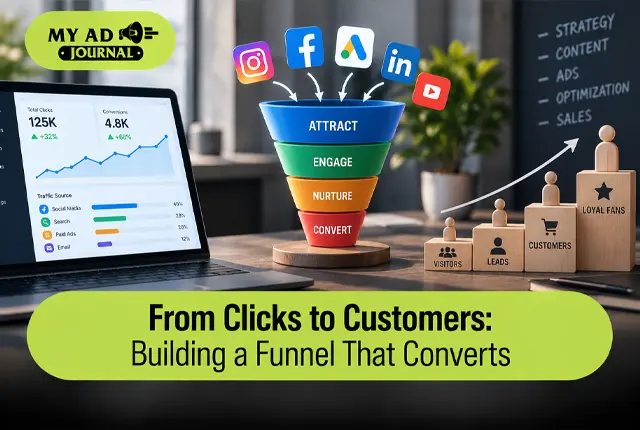
A marketing funnel represents the stages a potential customer moves through before completing a desired action. While different businesses may define the stages differently, the journey commonly begins with awareness and moves through consideration and conversion.
At the top of the funnel, people may be discovering a brand for the first time. They may see a social media post, search for information on Google, watch a video or click on an advertisement.
As they move further through the funnel, they begin evaluating whether the brand, product or service is right for them. They may read blogs, compare solutions, explore product pages, download resources or request more information.
At the bottom of the funnel, the prospect is closer to taking action. A clear offer, strong value proposition, customer reviews and a simple conversion process can help move them towards becoming a customer.
The funnel therefore provides a way to connect marketing activity with customer behaviour.
Why Marketing Funnels Matter for Business Growth
Not every visitor arrives with the same level of purchase intent. Someone searching for general information may not be ready to buy, while someone comparing prices may already be close to making a decision.
A strong conversion funnel recognises these differences.
Instead of immediately pushing every visitor towards a sales message, businesses can provide relevant content and experiences based on customer intent. Educational content can support early-stage visitors, while product comparisons, testimonials and consultations can help people who are closer to making a decision.
This approach can make marketing more relevant and create a smoother customer journey.
A funnel can also help businesses understand performance. If thousands of people visit a website but only a small percentage become leads, there may be an issue with the offer, messaging, landing page or conversion process.
Understanding each stage makes it easier to identify those opportunities.
Also Read: AI-Generated vs Human-Created Ads in 2026: Performance, Trust, and Conversion Analysis
The Key Stages of a Marketing Funnel
While funnels can be structured in different ways, a simple customer journey can be divided into awareness, consideration and conversion.
1. Awareness: Attract the Right Audience
The awareness stage is where potential customers first discover a business.
At this point, they may not know the brand or may not fully understand the solution they need. The objective is therefore to attract relevant attention rather than immediately make a sale.
Businesses can use search engine optimisation, social media content, blogs, videos, advertising, email marketing and other channels to reach potential customers.
The content should focus on topics, questions and problems that matter to the target audience.
For example, someone looking for ways to improve their website may initially search for information about website performance rather than a specific company.
A useful article or guide can introduce the brand while providing genuine value.
The quality of traffic matters as much as the volume. Thousands of visitors who have no interest in the offer may be less valuable than a smaller audience with a genuine need.
2. Consideration: Build Interest and Trust
Once people know about a brand, the next step is helping them understand why the business may be the right choice.
This is the consideration stage of the marketing funnel.
Potential customers may compare different providers, research solutions, read reviews or look for evidence that a business can deliver the promised results.
Content becomes particularly important here.
Detailed blog posts, case studies, product demonstrations, comparison pages, testimonials, webinars and downloadable resources can help answer questions and reduce uncertainty.
The messaging should move beyond simply explaining what the business offers. It should communicate how the solution addresses the customer’s specific needs.
Trust is also essential. Customers are more likely to move forward when they can see evidence of expertise, reliability and positive experiences from others.
3. Conversion: Turn Interest Into Action
The conversion stage is where a prospect takes the desired action.
This could mean purchasing a product, booking a consultation, submitting a form, starting a free trial or requesting a quotation.
At this stage, unnecessary friction can prevent lead conversion.
A complicated form, unclear pricing, weak CTA or confusing page structure can make a customer hesitate.
The conversion experience should therefore be straightforward.
The visitor should understand what they are being offered, why it matters and what they need to do next.
A strong call to action can provide direction, while supporting information such as testimonials, guarantees, reviews or FAQs can address final concerns.
Also Read: From Awareness to Conversion: Using Intent Signals Across the Funnel
How Content Supports the Marketing Funnel
Content plays a different role at different stages of the funnel.
Top-of-funnel content can attract people who are searching for information. Educational articles, guides, videos and social media content can introduce problems and possible solutions.
Middle-of-funnel content can help prospects evaluate their options. Case studies, comparison articles, product guides and webinars can provide deeper information.
Bottom-of-funnel content should help people make a decision. Testimonials, pricing information, product demonstrations and clear CTAs can support the final conversion.
This means businesses should not create content simply because a topic has search volume. Content should have a purpose within the customer journey.
A strong sales funnel strategy connects content with intent and helps move prospects naturally from one stage to the next.
5 Ways to Build a Funnel That Converts
1. Understand Your Target Audience
A funnel works best when it is designed around the people a business actually wants to attract.
Businesses should understand their audience’s challenges, motivations, questions, objections and purchasing behaviour.
Customer research, website analytics, surveys, sales conversations and feedback can all provide useful insights.
The better a business understands its audience, the easier it becomes to create relevant messaging for every funnel stage.
2. Create a Clear Value Proposition
Potential customers need a reason to continue through the funnel.
A clear value proposition explains what the business offers, who it helps and why the solution matters.
Instead of focusing only on product features, businesses should communicate outcomes.
For example, a software company could focus not only on its automation features but also on how those features can help customers reduce repetitive work and improve efficiency.
Clear value makes the offer easier to understand and can strengthen the path towards conversion.
3. Reduce Friction at Every Stage
Every additional obstacle can create an opportunity for a prospect to leave.
Businesses should examine the entire conversion funnel and identify areas where visitors may become confused, distracted or frustrated.
Are forms too long? Is the CTA easy to find? Does the landing page answer important questions? Is the checkout process complicated? Does the page work well on mobile devices?
Removing unnecessary friction can create a smoother customer experience.
4. Use Social Proof to Build Confidence
People often look for reassurance before making a purchase.
Customer reviews, testimonials, case studies, ratings and user experiences can provide valuable social proof.
For a new prospect, seeing evidence that other customers have successfully used a product or service can reduce uncertainty.
Social proof can be particularly useful towards the middle and bottom of the funnel, where prospects are actively evaluating whether they should take action.
5. Keep Testing and Improving
A funnel should not be treated as a one-time project.
Customer behaviour can change based on the audience, offer, traffic source, device and market conditions.
This makes conversion rate optimization an ongoing process.
Businesses can test headlines, landing pages, CTA wording, forms, offers, layouts and other elements to understand what improves performance.
Instead of relying on assumptions, marketers can use actual performance data to identify opportunities.
Understanding the Sales Funnel Strategy
A strong sales funnel strategy connects marketing activity with the sales process.
Marketing may attract and educate potential customers, while sales may take over when prospects become more qualified.
Without alignment, leads can fall through the gaps.
For example, marketing may generate a large number of leads, but if sales does not have enough information to understand those prospects or follow up effectively, the overall funnel may perform poorly.
Businesses should therefore establish clear processes for lead qualification, follow-up and communication.
A prospect who downloads an educational guide may need nurturing before receiving a direct sales offer. Someone requesting a product demonstration may already have stronger purchase intent.
Recognising these differences can help businesses prioritise leads and create more relevant follow-up experiences.
Also Read: From Clicks to Conversions: The Ultimate Guide to Performance Marketing
The Role of Conversion Rate Optimization
Generating traffic is important, but traffic alone does not guarantee business growth.
Conversion rate optimization focuses on improving the percentage of visitors who complete a desired action.
This can involve analysing user behaviour, identifying weak points and testing different approaches.
For example, a landing page may receive significant traffic but generate very few leads. The problem could be the headline, offer, CTA, form or overall messaging.
Instead of spending more money simply to generate additional traffic, a business may first benefit from improving the experience for visitors it already has.
Even small improvements at important funnel stages can have a meaningful impact on overall performance.
How to Improve Lead Conversion
Lead conversion depends on more than generating contact information.
A lead needs to receive the right information and experience at the right time.
Businesses can improve lead conversion by creating relevant follow-up emails, personalised offers, useful resources and clear next steps.
Lead nurturing can be particularly valuable for customers who are interested but not yet ready to purchase.
For example, someone who downloads a guide could receive additional educational content before being introduced to a consultation or product offer.
The objective is to build confidence rather than pressure the prospect into making an immediate decision.
Measuring Marketing Funnel Performance
A funnel becomes more useful when businesses measure what happens at each stage.
Important metrics may include website traffic, engagement, landing page conversions, lead volume, qualified leads, sales conversion rates and customer acquisition costs.
Looking at these metrics together can reveal where the biggest opportunities exist.
A business may discover that its awareness campaigns generate strong traffic but few leads. Another may have plenty of leads but a low sales conversion rate.
These situations require different solutions.
Measuring the entire customer acquisition funnel helps businesses move beyond surface-level metrics and understand how marketing activity contributes to actual business outcomes.
Common Marketing Funnel Mistakes
One common mistake is focusing too heavily on the top of the funnel.
Generating views, clicks and website traffic can look impressive, but these metrics do not automatically translate into customers.
Another mistake is creating the same message for every stage.
A person discovering a brand for the first time needs different information from someone who is ready to purchase.
Businesses should also avoid making the conversion process unnecessarily complicated. Too many forms, unclear CTAs, excessive navigation and irrelevant information can create friction.
Finally, businesses should not assume that every funnel must follow exactly the same structure. Customer journeys vary by industry, product, price and buying cycle.
The best funnel reflects the actual behaviour of the target audience.
How to Build a Customer Acquisition Funnel
Creating an effective customer acquisition funnel starts with defining the desired business outcome.
Businesses should identify who they want to attract, what problem they solve and what action they want visitors to take.
The next step is to map the customer journey from first interaction to purchase.
Each stage should have an appropriate message, content format and CTA.
Businesses can then monitor performance and identify where prospects are leaving the funnel.
The process should continue after the first purchase as well. Existing customers can become repeat buyers, advocates and valuable sources of referrals and reviews.
A complete funnel therefore considers not only how to acquire customers but also how to retain and grow those relationships.
Final Thoughts
A successful marketing funnel is more than a diagram showing different stages of a customer journey. It is a strategic framework for understanding how people discover, evaluate and ultimately choose a brand.
From attracting relevant traffic to building trust, nurturing leads and simplifying the final conversion, every stage has an important role.
The strongest funnels do not try to force every visitor to buy immediately. They provide the right information at the right stage and create a clear path towards action.
By combining useful content, strong messaging, thoughtful conversion rate optimization, effective lead nurturing and a well-planned sales funnel strategy, businesses can turn more clicks into meaningful customer relationships.
The goal is not simply to attract more visitors.
It is to create a journey that gives the right visitors a reason to stay, trust the brand and take the next step.
Turn Clicks Into Customers
Ready to turn more website traffic into qualified leads and customers? My Ad Journal helps brands create strategic content, conversion-focused messaging and digital marketing strategies designed to move audiences from awareness to action.
FAQs
What is a marketing funnel?
A marketing funnel is a framework that represents the stages a potential customer moves through, from discovering a brand to considering an offer and eventually taking a desired action.
What is the difference between a marketing funnel and a sales funnel?
A marketing funnel generally focuses on attracting and nurturing potential customers, while a sales funnel focuses more closely on moving qualified prospects towards a purchase. In practice, the two often work together.
How can businesses improve their conversion funnel?
Businesses can improve their conversion funnel by understanding customer intent, creating relevant content, strengthening value propositions, reducing friction, using social proof and continuously testing important funnel elements.
What is conversion rate optimization?
Conversion rate optimization is the process of improving a website, landing page or customer journey to increase the percentage of visitors who complete a desired action.
How does a customer acquisition funnel help businesses?
A customer acquisition funnel helps businesses understand how prospects move from first discovering a brand to becoming customers. It can also help identify where potential customers leave the journey and where improvements can increase conversions.